
Marathon Session: Sine die
Taxes: the good, the bad and the ugly.

Marathon sessions in the Iowa legislature aren’t about efficiency; they’re about exhaustion. They’re designed to wear members down. To force votes in the wee hours of the morning on bills that couldn’t pass in the light of day, when everyone is alert, prepared, and ready to fight.
They’re about dropping the most controversial proposals at 5:30 a.m., hoping the minority party will finally give in and think, “They’re going to do it anyway. We’re too tired to keep fighting.”
But that’s not how this works.
On days when I suspect a shutdown is coming, I prepare. I wear my Nikes. I bring real food — fruits and vegetables, hoping to avoid fast food and vending machine snacking. I make sure there’s ibuprofen in my desk drawer.
Earlier in the week, I was cleaning out my desk drawer and found three new toothbrushes, a travel-size tube of toothpaste, and some floss. I almost took them home. But something told me to leave them.
I was right.
By the time the marathon stretched on, those small things mattered. I was able to hand out toothbrushes to three of us, toothpaste to four. It’s funny what becomes essential at 3 or 4 in the morning.
That’s the part people don’t always see.
We come prepared with Nikes, snacks, and ibuprofen. We share what we have, things we’ve stashed away over the course of a session, sometimes over years of serving.
Because when the hours drag on and the pressure builds, it’s about endurance and solidarity.
One of our newer members said, “This is only my second overnighter, and they are both miserable but also a way to bond with my colleagues.”
And then, at 5:30 a.m., the moment came.
The majority party placed on the agenda a controversial constitutional amendment that would make it extremely difficult to raise income taxes on corporations and the wealthiest Iowans. It felt like a punch to the gut. I wondered: would we cave? Would we decide we didn’t have it in us to keep fighting?
We regrouped.
In caucus, Minority Leader Brian Meyer laid it out clearly: we had two amendments ready — and he asked, “What other amendment ideas do you have?”
So we got to work.
By around 6 a.m., we had filed nine amendments. They were meant to expose the real implications of the proposal. Representatives Dave Jacoby, Angel Ramirez, Aime Wichtendahl, Larry McBurney, and Jennifer Konfrst all stepped up to file, study, and prepare to run them on the floor.
Among them:
Requiring a supermajority to raise taxes on anyone making less than $1 million a year — while preserving the ability to raise them on corporations and the ultra-wealthy
Requiring a supermajority to tax food, highlighting the risk that Iowa could shift toward more regressive taxation
Requiring a supermajority to increase funding for private schools
Requiring a supermajority for increases on sales taxes, fees, and health care-related taxes
Even requiring a supermajority to raise legislative salaries or create corporate tax credits
The point was simple: if we are going to lock in barriers to revenue, Iowans deserve to understand exactly what that means.
Behind the scenes, there’s another layer. Every amendment has to go through the Legislative Services Agency (LSA) to be drafted, reviewed, approved, signed, and formally filed. We estimated it would take about two hours.
And all of this was happening while LSA staff, who had already been working for nearly 24 hours, were also drafting major bills for the majority party.
After requesting the amendments, we were still in the caucus room, running on fumes.
That’s when Representative Adam Zabner said, “If anyone wants McDonald’s, text me your order and Venmo me — I’ll go pick it up.”
By then, my healthy food was long gone. I took him up on it.
On the drive home later that day, that moment stuck with me. The simple act of someone making sure we could eat. I hadn’t slept in nearly 48 hours, but it meant a lot.
After eating, I found a few minutes to step away. I went to my car, pulled a jacket over my head, and managed a 20-minute nap. When I came back, I told Representative Angel Ramirez how much better I felt. She laughed and said, “Keep saying that — maybe it’ll make the rest of us feel better too.”
At 11:10 a.m., we finally gaveled back into debate.
In between, time blurred. There were bagels and cream cheese dropped off by Representative Josh Turek. Bits and pieces of the property tax and budget bills started to surface, sparking quiet concern and conversations in the room. Representative JD Scholten had missed some of the overnight hours due to prior obligations, but he showed up Sunday morning ready to help, offering to make food and coffee runs and carry the load while the rest of us were running on empty.
We didn’t win the battle on HJR 11, but we won the messaging. Targeting income taxes will force future legislatures into difficult decisions about how to fund basic services. This amendment does not protect Iowans from tax increases; it only protects them from income tax increases. Furthmore, the last time the income tax was raised was in 1975 and the last time the corporate income tax was raised was in 1982. Since then there have been many reductions to both.
There were many people who spent that night and the next day at the Capitol working: the press, House and Senate caucus staff, doorkeepers, pages. At 8 a.m., when it became clear we had another full day of work ahead, the Chief Clerk’s office reduced the doorkeeper staff to two pages and sent everyone else home.
That’s what these marathon sessions really are.
Exhaustion. Strategy. Small acts of kindness. Moments of doubt — and a few small victories.
See my last newsletter for more on HJR 11
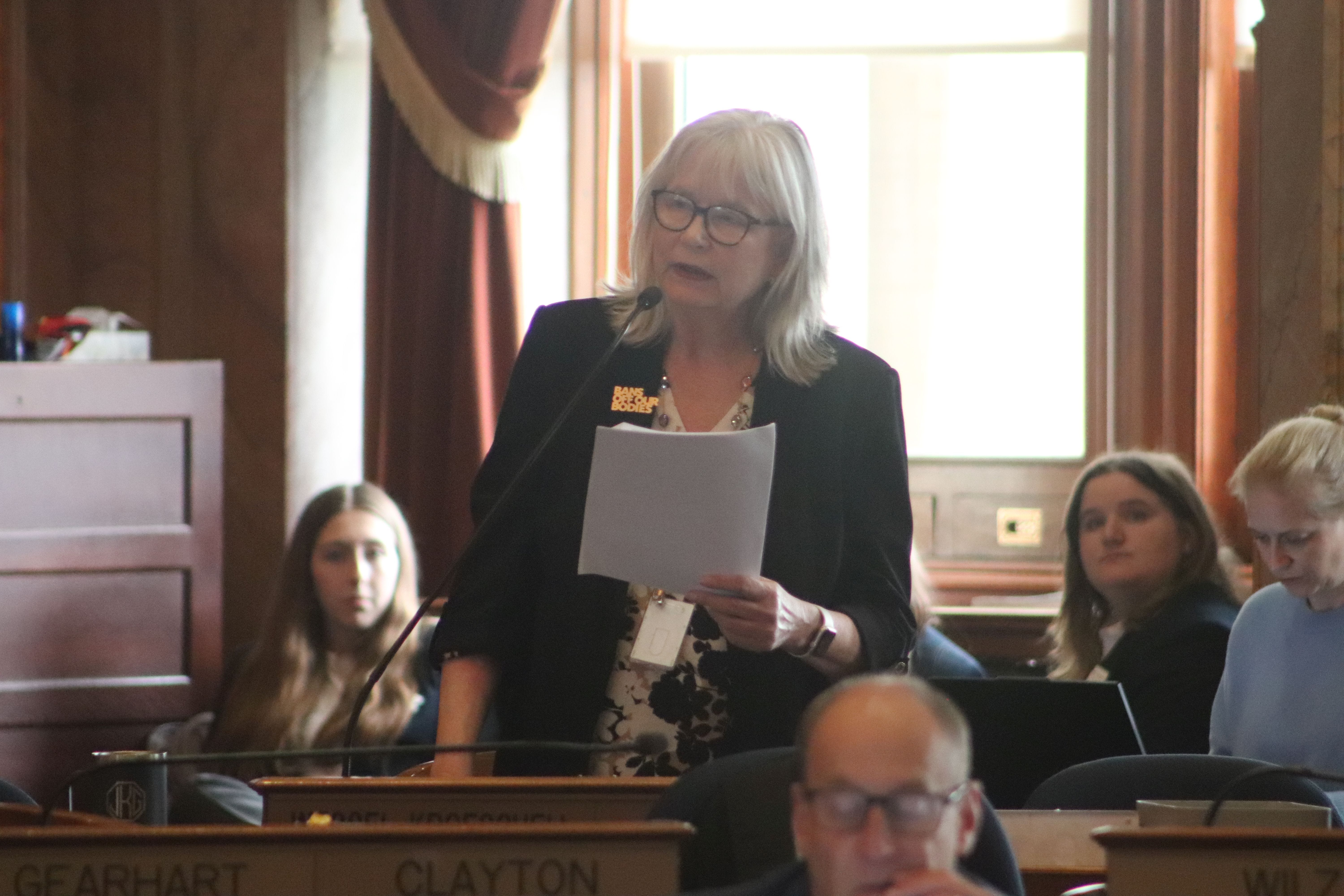
Beth speaking in opposition to the medication abortion bill.